summary
Ask FT is an AI-powered research assistant launched to 1.5 million subscribers. It enables subscribers to explore the FT’s extensive article archive and receive AI-generated answers, complete with citations and direct links to the original reporting.
I led the end-to-end product design and creative direction of the feature across responsive web and native app platforms. Beyond delivering a seamless cross-platform experience, the project also marked the rollout of the new FT Professional visual identity—helping to unify and elevate the brand across key touchpoints.
The result was a fully integrated, trusted tool that empowered business users to extract insights from FT journalism quickly and confidently. It also helped position FT Professional as a distinct, premium offering in a competitive market—reinforcing its value through a clear and differentiated brand experience.
9 months
testing and refining
7,000
organisation AI policies
1.5 million
adopted subscribers
Vision
Ask FT was envisioned as a generative AI tool designed to make it effortless to search, summarise, and extract insights from FT journalism—empowering users to get the answers they need and complete their tasks more efficiently.
With the growing demand for faster, smarter access to trusted information, we set out to create additional value for FT Professional subscribers as part of their subscription. Additionally, we wanted to encourage subscription leads and attract new business readers by showcasing the FT’s innovation in AI-assisted research, and the product’s ability to surface high-value insights quickly and reliably.
Whether a subscriber was preparing for a client meeting, writing a report, or exploring macroeconomic trends, Ask FT would act as a responsive, context-rich tool to make sense of complex financial and business topics through FT reporting — all within seconds.
ROLE & RESPONSIBILITIES
I was responsible for both strategy and execution across all platforms. My work included:
- End-to-end process from discovery to design fulfillment for Ask FT across responsive web and native app platforms
- Leading creative direction for the FT Professional re-brand within Ask FT
- Creating wireframes, prototypes, component libraries and final UI designs
- Supporting research with prototypes, usability testing and creating test hypotheses
- Collaborating closely and cross-functionally with product, AI/ML, and engineering teams

GOAL METRICS
We had a clear sense of what success looked like, but initial research conducted helped to validate and refine our approach. We defined our metrics as:
- Drive engagement with Ask FT by making it easy to find and use
- Ensure high comprehension and trust in the generated answers
- Encourage habitual, repeat usage among Professional users
- Strengthen perception of FT as an innovator in the journalism and B2B space to encourage new organisation leads, subscribers and additional seats
DISCOVERY & RESEARCH
In collaboration with research and data teams, we launched a discovery phase to understand subscriber expectations, behaviours, and concerns when interacting with AI-powered tools in a journalistic context.
We started by mapping the core value propositions of Ask FT, aiming to validate how users might trust, engage with, and navigate AI-generated responses. By combining qualitative and quantitative methods, we gained a well-rounded view of user needs, helping to shape and reinforce our product direction.

Stakeholder interviews
We conducted generative research with editorial, data science, and product leadership to align on our vision, goals and possible constraints.
Competitive analysis
I benchmarked emerging AI tools from The New York Times, Bloomberg, Washington Post and academic platforms to understand mental models and interface patterns.
User interviews
We interviewed 15 business professionals, analysts, and long-time FT readers to understand their research workflows, their trust in generative AI, and how they currently find and use FT content.
User surveys
A lightweight in-product survey was deployed at contextual moments within the current FT platform — primarily search and topic pages — to assess interest in AI-powered assistance, as well as trust in citations and summarised content.

RESEARCH INSIGHTS
Utilising these methods, we were able to gather valuable insights and user feedback to understand the landscape and . We found that:
Credibility equals trust
Users were open to AI-generated summaries, but insisted on transparency. Citations and access to original articles were non-negotiable for trust.
Clarity in generated responses
Business users preferred clear, concise answers over conversational or overly creative AI output. Participants also mentioned the ability to tailor and tweak the date ranges of responses.
Search fatigue exists
Many users admitted to struggling with keyword-based archive searches and welcomed a more intuitive, query-based system.
AI anxiety
Some users expressed hesitation about potential bias or hallucinations in AI answers, reinforcing the need for clear boundaries and explainability in the UI.
These insights directly shaped the prioritisation of features, such as a simple and minimal UX and UI, inline citations, accessible source previews, specific date ranges and tone-tuned answer formatting.

TESTING
We validated early concepts through unmoderated prototype tests with a mix of FT Professional subscribers and prospective users using the dscout platform. Each participant was guided through realistic, goal-based tasks to assess the usability and clarity of the experience, such as:
- Find insight for a board presentation on inflation
- Summarise the FT’s position on ESG investing
- Navigate to a historical question and remove it
- Find a source reference and navigate to the source text
Running usability tests at this stage enabled us to make quick design decisions and focus on improvements that mattered most to real users. These early learnings were critical to refining Ask FT into a more trustworthy and efficient research tool.
TESTING INSIGHTS
During these usability sessions, we noted and documented common themes that were provided in feedback:
Goal-driven queries were intuitive
Most users quickly understood they could ask high-level research questions and receive relevant summaries with source links.
Speed of results determined product confidence
The average time to generate a response was poor—at around 20-30 seconds on average in our test environment. Users appreciated the clarity of the answers, particularly the use of citations and links back to trusted journalism, but found the wait to be too long.
Citations built trust
Inline references to FT articles, with clickable links, reassured users and encouraged deeper exploration.
Deleting historical queries was unclear
Some users had trouble identifying how to remove a past question. Icon affordance and placement of the delete action needed refinement.
Overwhelming summaries
In some cases, the AI output was too dense or academic. We iterated on tone and scannability, introducing subheadings and collapsible sections for clarity.
By listening closely to early user feedback, we introduced meaningful updates, like improved answer quality, clearer source referencing, and smarter handling of complex queries, that made the tool more useful and trustworthy.

DESIGN PROCESS
Using a lean process, I iterated on the prototypes and built an MVP quickly using a modular-based system. We could deploy a quick test with the same participants to validate and refine accordingly. With this, I also:
Revised architecture and layout
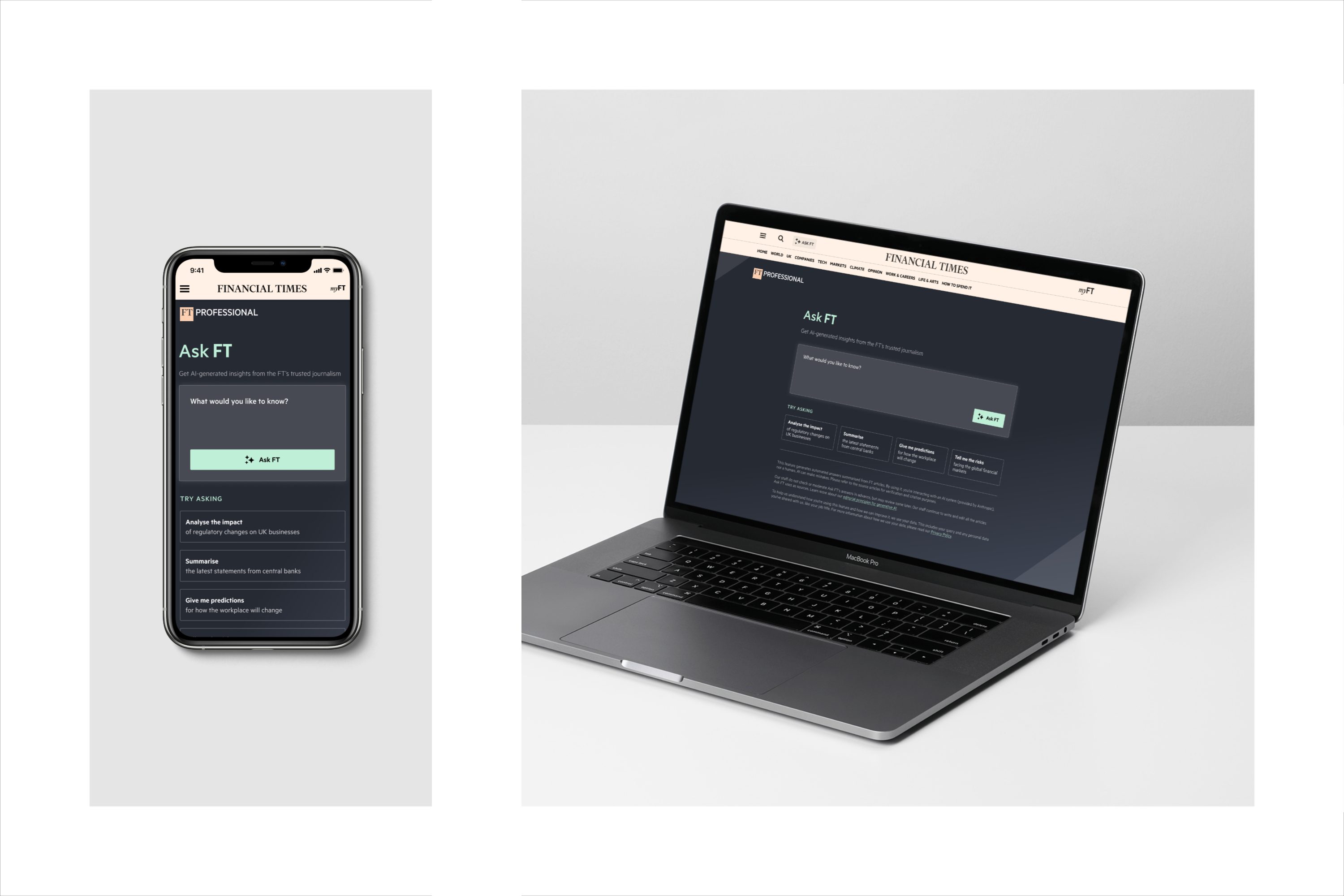
We developed a flexible layout that could adapt seamlessly across breakpoints — desktop, tablet, and mobile. I paid particular attention to legibility, content hierarchy, and component behaviour at smaller screen sizes.
Integrated a refreshed and differentiated brand
I started by applying the new FT Professional visual identity — using a refined colour palette, the new slate background, updated typography, and a clean illustration style. This established a clear, consistent aesthetic aligned with FT’s B2B goals.
Adopted prompts and input intuitiveness
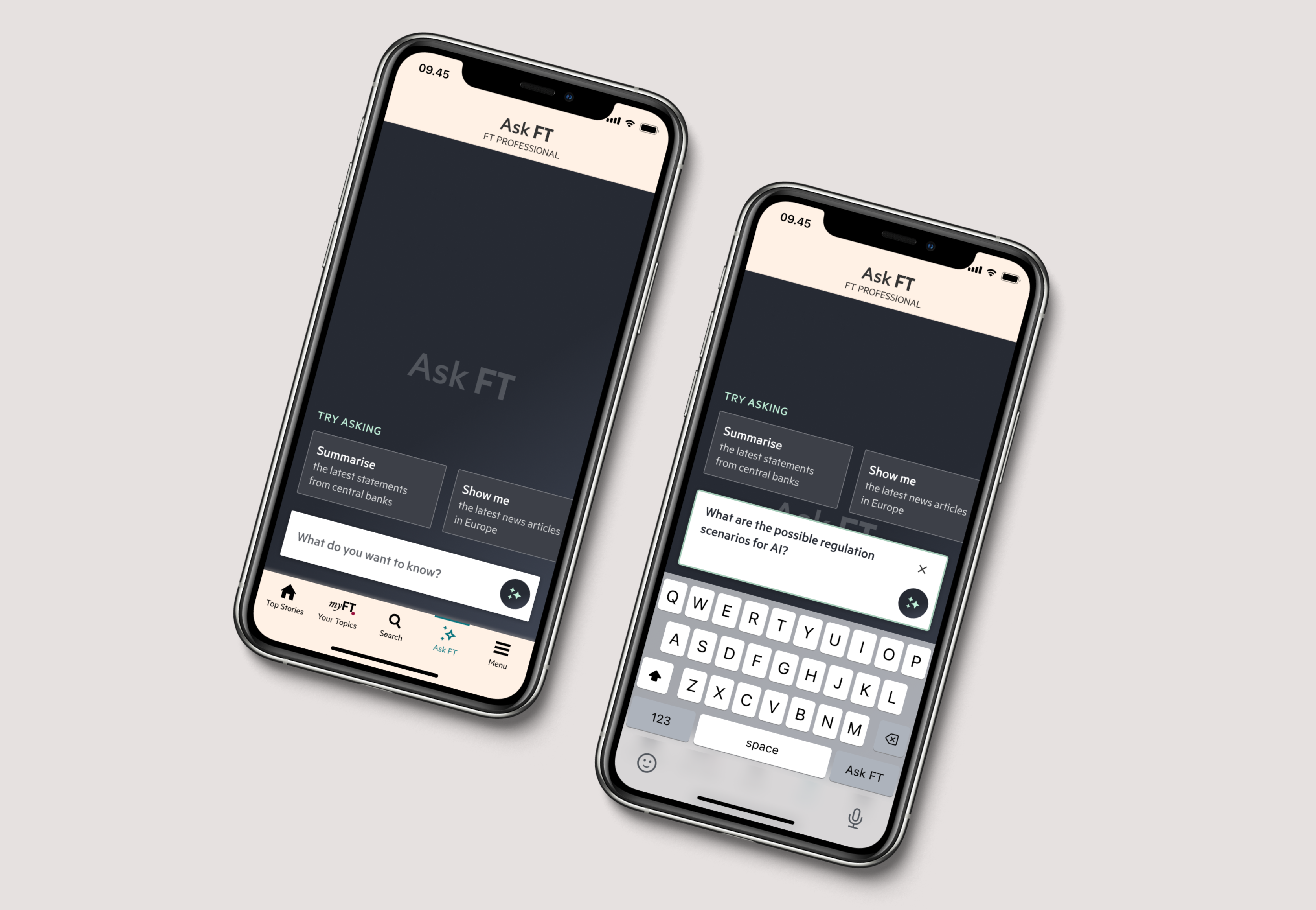
To encourage use, I designed a welcoming entry point with suggestions for what to ask — based on frequent queries and editorial insights. Microcopy was introduced to clarify what kind of questions worked best, and we evolved the input design to feel more intuitive and less transactional.
Created a modular design system
A modular system helped to improve AI-generated answers, and ensured responses were easy to scan but were authoritative. Citations were made expandable with a bottom sheet, and collapsible for focus, yet always accessible for transparency. Trust signals, such as author avatars, topics and relevant signposting were added to reassure users.
Added app integration and native enhancements
For the native app, we adjusted spacing, font sizing, and interaction patterns to feel conversational and comfortable. I worked closely with engineers to maintain a seamless experience while ensuring fast load times and touch-friendly UI elements.
IMPACT
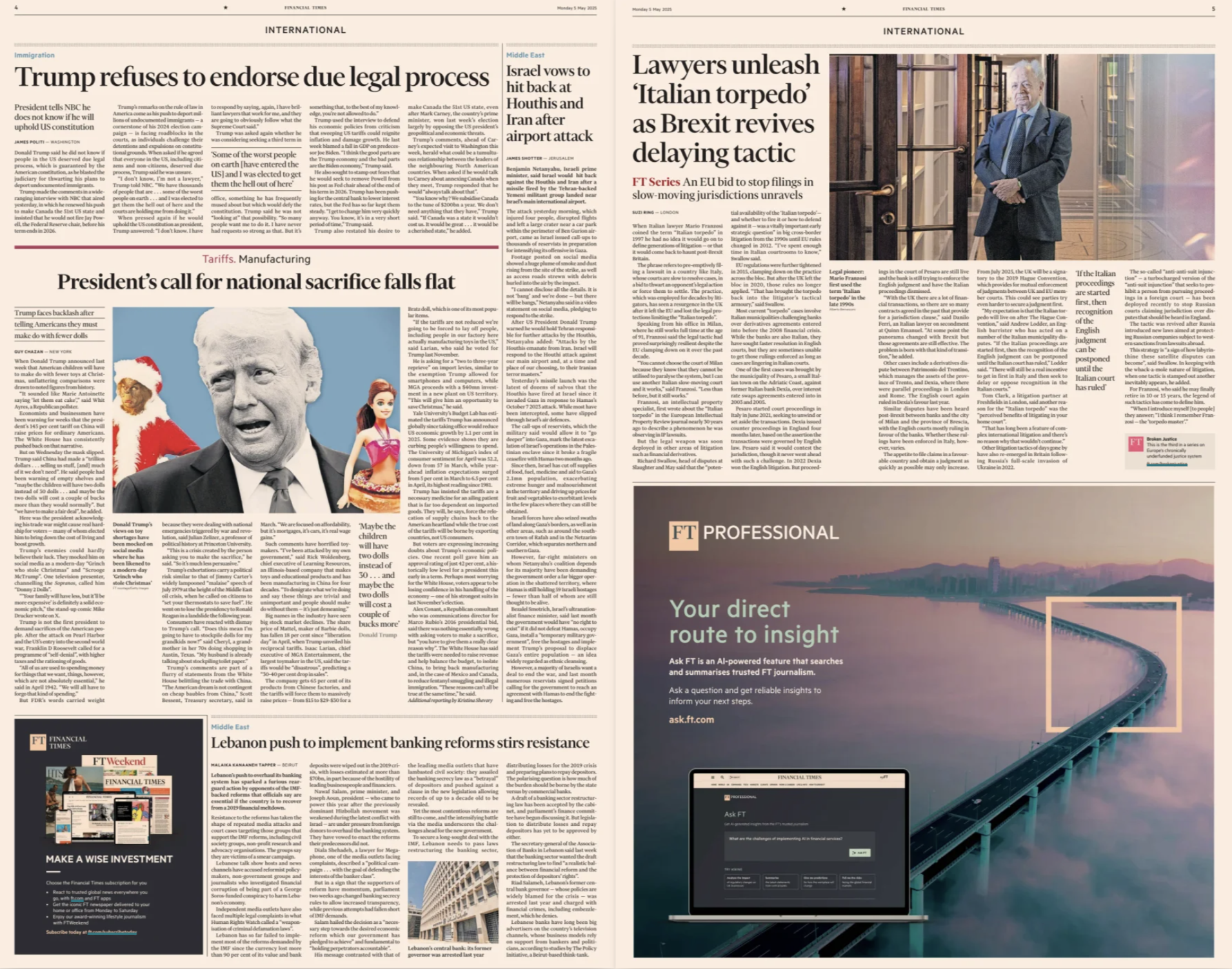
The redesigned Ask FT helped position the FT as a forward-thinking leader in AI-assisted journalism. Users responded positively to the integration of AI while maintaining journalistic integrity. The rebrand increased visual coherence across the FT Professional suite and reinforced trust.
- Successfully launched to 1.5 million active subscribers
- 82% of users adopted the platform, with an average of 3 questions asked*
- 38% increase in weekly active users within the first month of launch*
- 2.5x increase in queries submitted per session compared to MVP*
- High reuse rate with 1 in 3 users returning to Ask FT within a week*
* as of April 2025

KEY LEARNINGS
While the launch was successful, it was important to reflect on what could be improved for future projects of this scale.
Working with new teams
Getting new editorial and compliance stakeholders aligned on the product vision took time. Early involvement and proactive communication helped build trust and streamline decision-making.
Navigating a new platform
Designing for a generative AI product posed unique challenges — especially in guiding user expectations, displaying machine-generated output responsibly, and maintaining trust.
Tight timelines with limited QA
Operating on a tight delivery schedule meant we had to be selective about what to test. Prioritising the most critical flows for validation helped us keep moving without compromising on usability. Due to the delivery date, we had to rush QA which wasn’t ideal.
Balancing feedback with multiple stakeholders
With input from product, legal, the apps team, and AI/ML teams, aligning feedback into coherent next steps was essential. Clear documentation and shared Figma prototypes helped create a central source of truth.
Being bolder and stronger with rebranding
Being bolder with branding and using the slate and mint styles was the right decision. The directive but consistent tone of voice and messaging strongly resonated with users and enhanced product trust.
In the Press
Financial Times Blog Post
Feature Article
NEXT PROJECT
FT Brand Refresh
“Ed has played a pivotal role in shaping our product experiences. He was able to translate complex data sets into valuable insights for users through intelligent designs”.
— Tanya Brady-Halligan, Delivery Manager, The Financial Times
 Ed Fairman